Physical Address
Austin, TX, USA
Physical Address
Austin, TX, USA

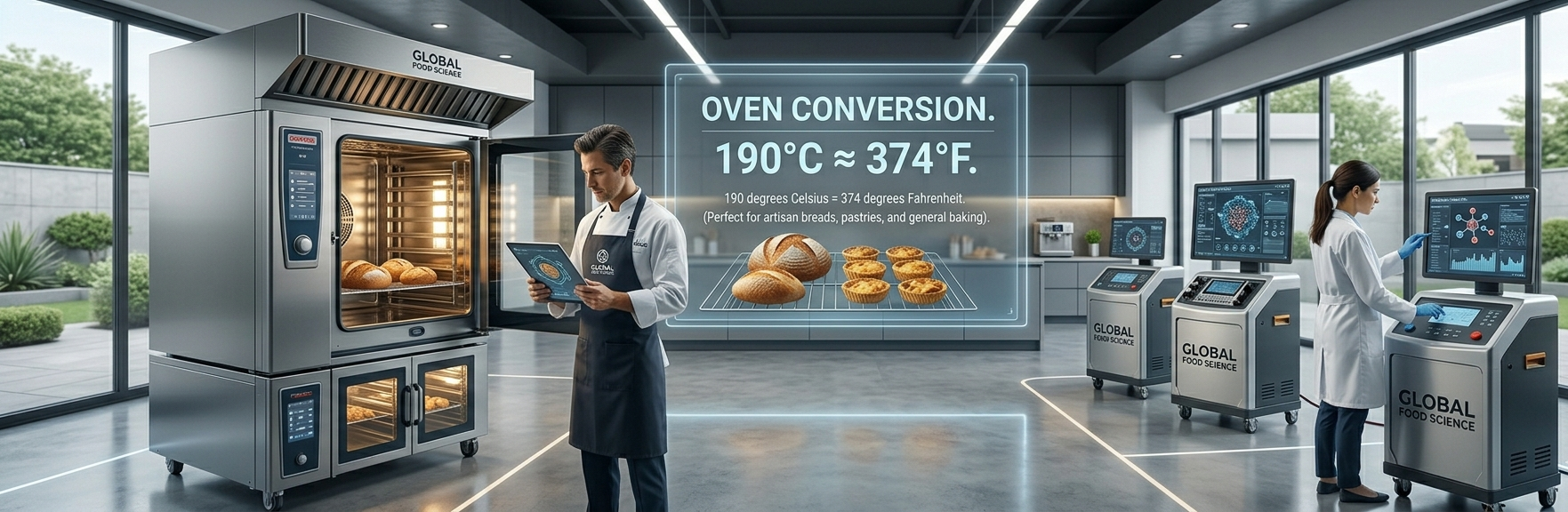
If you have ever followed a recipe from another country, used an imported oven, or compared temperature settings online, you may have wondered about 190 C as Fahrenheit. Temperature conversions are among the most common questions in cooking and baking because recipes often use different measurement systems depending on where they were created.

Converting the temperature of 190° Celsius to Fahrenheit will ensure precise cooking results, avoid over- or undercooking, as well as ensure quality in your kitchen. When you bake cookies or roasting veggies, making meat, or making use of an air fryer understanding the right temperature conversion is vital.
In this thorough guide, you’ll be able to understand the exact Fahrenheit equivalent to 190degC. You’ll also learn how the conversion is done, the importance of it for cooking, practical ways to use it such as oven temperature comparisons and expert advice for getting more efficient results each time.
Temperature is 190 C in Fahrenheit is equivalent to:
374degF
This conversion is done by using the standard method of temperature conversion:
Temperature (degF) = (Temperature (degC x 9/5) + 32)
By applying the formula:
190 x 9/5 = 342
342 + 32 = 374
Therefore:
190degC = 374degF
In many recipes the temperature is usually reduced to 350degF or commonly referred to as a moderate to high oven temperature.
A precise temperature conversion is crucial since even minor differences could alter the cooking results.
A cake that is baked with the right temperature might not rise correctly. Roasted vegetables can be too soft or begin to burn too quickly. Bread can form a sloppy crust.
Experienced bakers and professional chefs know that temperature control directly affects:
If recipes are written in Celsius however your oven is displaying Fahrenheit, an accurate conversion can help to ensure that the cooking conditions are maintained.
Before delve into the more specific applications, it’s helpful to know the differences between the two scales of temperature.
It is the Celsius scale has been widely utilized throughout Europe, Asia, Australia and the majority of the world.
The Fahrenheit scale is still widely used in the United States and a few other countries.
Although both scales indicate temperature, their numbers differ dramatically.
For instance:
The temperature of water freezes when:
The temperature of water is:
Due to these differences due to these differences, proper conversion is crucial when working using international recipes.
The reason why people often look for the number 190 C in the form Fahrenheit because it is frequently used in recipes.
This temperature is perfect for creating a equilibrium between browning and cooking.
A variety of sponge cake, pound cakes and butter cakes are baked successfully at temperatures of around 190 degrees Celsius.
The temperature of the batter allows it to rise evenly and develop an attractive golden surface.
Vegetables like carrots, potatoes Brussels sprouts and even cauliflower cook beautifully at 190°C.
The heat stimulates caramelization but not burning excessively.
The thighs, breasts and chicken breasts and drumsticks cook well at temperatures of 190 degrees Celsius.
The temperature causes browning and helping to maintain the moisture.
Many cookie recipes suggest temperatures of 190 degrees Celsius or more because they promote sharp edges and soft centers.
Pasta, lasagna and casseroles benefit from moderately high temperatures that guarantee uniform cooking throughout the dish.
The following table offers useful temperature reference for baking and cooking.
| Celsius | Fahrenheit | Cooking Level |
|---|---|---|
| 160degC | 320degF | Low-Moderate |
| 170degC | 338degF | Moderate |
| 180degC | 356degF | Moderate |
| 190degC | 374degF | Moderate-High |
| 200degC | 392degF | High |
| 220degC | 428degF | Very High |
| 230degC | 446degF | Extremely High |
This can help home cooks quickly determine the equivalent temperature across different recipes formats.
Practically speaking, yes.
The majority of modern ovens aren’t perfect and tend to fluctuate little in operation.
Since 374degF is close to 375degF in temperature, recipes typically use them interchangeably.
Professionals typically have temperatures that are round to ensure convenience.
Thus when a recipe calls for the temperature at 190°C, and your oven permits Fahrenheit settings, then selecting the setting of 375degF is totally acceptable.
A lot of home cooks believe that their ovens display the exact temperature inside.
However, oven calibration varies.
Certain ovens are more hot than they are indicated, whereas others are operating somewhat cooler.
This is the reason two people using the same recipe may get different outcomes.
An oven thermometer is a great tool to determine the actual temperature and help improve the consistency of cooking.
At temperatures of 190degC, or 374degF, even a difference between 15 and 20 degrees can affect the baking performance.
Another crucial aspect to consider is the oven’s type.
Air-cooled ovens that circulate hot air through inside the cookery chamber.
The increased airflow usually ensures that food cooks more quickly and more evenly.
When it comes to converting temperatures, most recipes suggest reducing the setting just a bit in fan ovens.
For instance:
Always refer to your appliance’s manual to learn about the recommendations of the manufacturer.
Air fryers are more popular because of their efficiency and speed.
Since air fryers circulate heat faster in comparison to traditional ovens. Temperature adjustments might be required.
If a recipe requires the temperature to be 190 degrees Celsius in a conventional oven, temperatures for air fryers typically require slight decreases.
This prevents excessive browning while ensuring proper cooking time.
Many cooks discover that cutting down the temperature by 10-20 degrees Celsius gives fantastic outcomes.
Baking is usually described as an art.
Tiny temperature fluctuations could affect:
When you are working in delicate bake goods like pastries, macarons, and breads made by artisans, exact temperature control becomes crucial.
Professional bakers typically utilize digital thermometers and calibrated ovens to guarantee the same outcomes.
This is why understanding precisely how you can convert 190 C is interpreted as Fahrenheit converts will lead to better baking results.
The concept of the value of 190 degrees Celsius in Fahrenheit is vital for those who cook or bakes, or who follows international recipes. The precise calculation to be used is 374degF that is usually round into the 375degF mark in kitchens of all kinds. This moderately high temperature is commonly employed to roast vegetables baking cakes, roasting chicken, making casseroles, as well as many other culinary uses.
Accurate temperature conversion can increase consistency, improve the quality of food, and minimize mistakes in cooking. No matter if you’re using a conventional oven or fan oven or an air fryer being able to use 190 degrees Celsius will ensure higher quality results and more confidence at the table.
As the world’s recipes continue to increase in popularity, mastering the basics of conversions such as 191 C as Fahrenheit is an essential knowledge for home cooks as well as professionals.
190degC converts into exactly 374degF.
Yes. The majority of recipes and ovens consider 374degF and 375degF in the same way.
Yes. It is usually regarded as to be a moderate-to-high roasting and baking temperature.
Cakes, cookies, roast chicken, vegetables, casseroles and baked pasta dishes are typically cooked at this temperature.
A lot of countries utilize the Celsius scale for their standard measurement of temperature, whereas it is the United States primarily uses Fahrenheit.