Physical Address
Austin, TX, USA
Physical Address
Austin, TX, USA

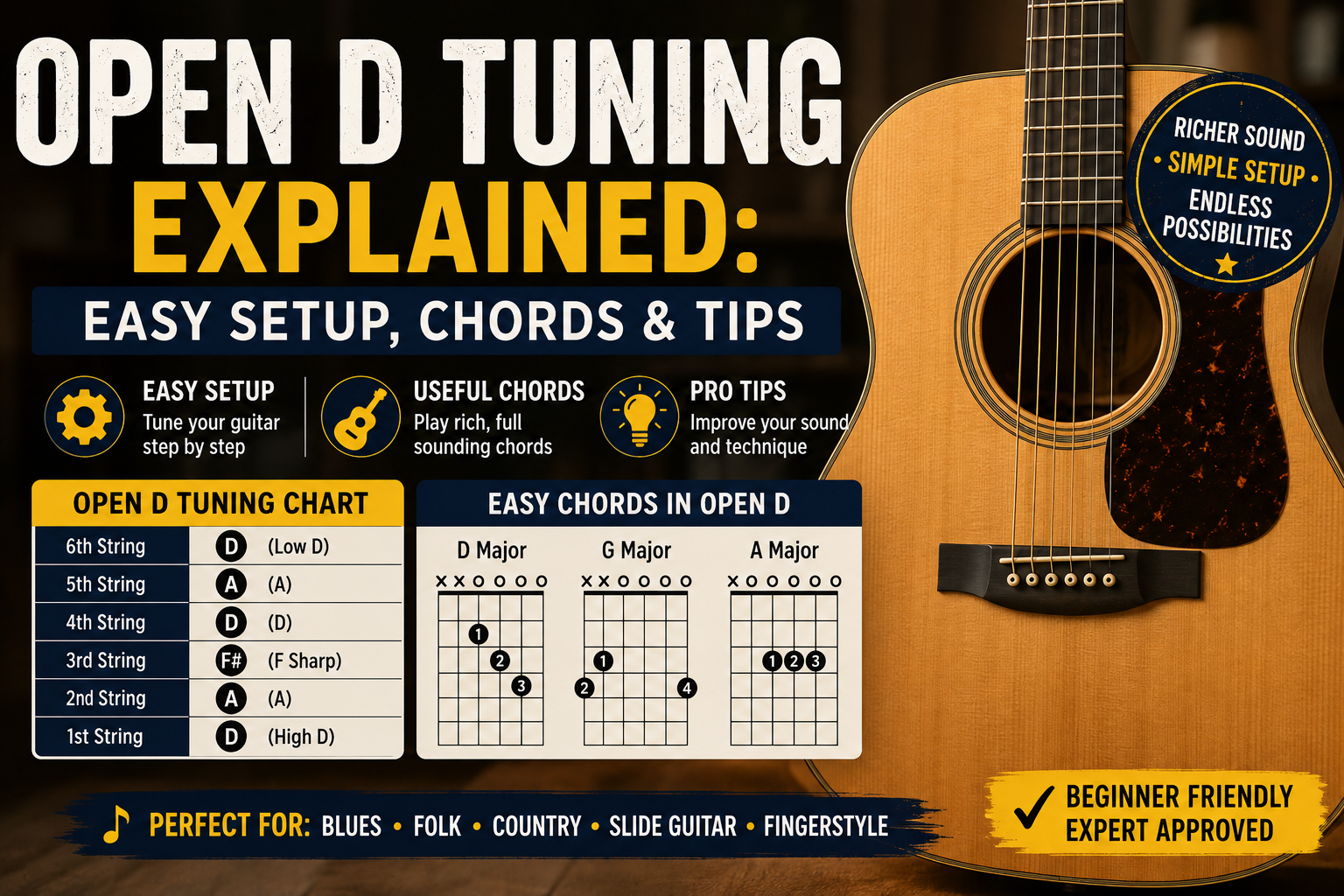
Open D tuning is among the most popular alternative guitar tunings that are used by beginner as well as professional musicians. It transforms an ordinary guitar into a instrument capable of creating deep, resonant chords that require only a tiny amount of movement. If you like blues or folk, country or rock fingerstyle music, the Open D tuning can provide endless musical possibilities.
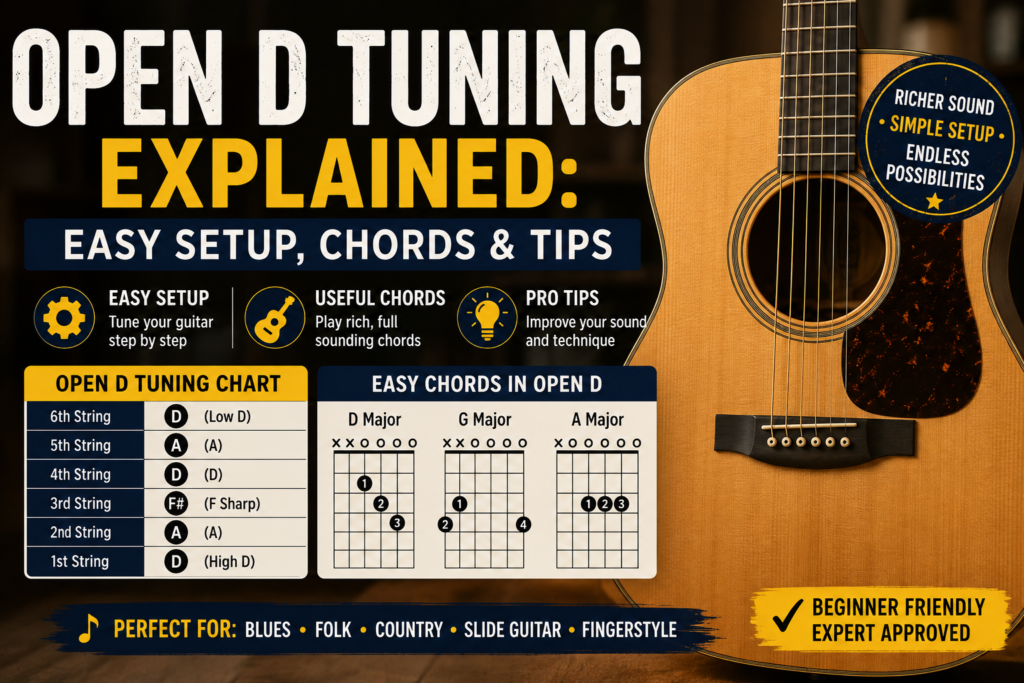
In this 2026 tutorial we’ll explain precisely about what Open D tuning is, how to tune your guitar properly as well as the reasons why many of the world’s top guitar players use it, and strategies to help you learn this extremely flexible tuning. If you’ve never tried other tunings prior to now, Open D is an excellent place to begin.
The Open D tuning a different guitar tuning that lets the strings open create the D Major chord when played without pressing frets. In contrast to conventional tuning (E-A-D-G-B-E) the strings can be tuned to create a an even more full and resonant sound.
This is how it works:
| String | Standard Tuning | Open D Tuning |
|---|---|---|
| 6th | E | D |
| 5th | A | A |
| 4th | D | D |
| 3rd | G | F# |
| 2nd | B | A |
| 1st | E | D |
This tuning makes a clear, bright sound that is ideal for fingerpicking, slide guitar and exuberant chord progressions.
Another one of the reasons Open D tuning remains popular is the simplicity. Because the open strings create a full D major chord anyone can make beautiful harmonies with a minimum effort. Barre chords become more easy to play, and a lot of songs sound richer and more powerful without intricate finger positions.
Professional musicians also love Open D because it encourages creativity in songwriting. Different string relationships create fresh chord voicings and melodic concepts which aren’t possible to achieve in normal tuning.
Moving from Open D offers several advantages for players of any skill level.
The tuning naturally creates the sound of a warm, resonant resonance that improves acoustic playing. Slide guitar technique becomes more smooth since a straight line across a fret instantly generates major chords. Fingerstyle guitarists benefit from more rich bass notes and sustain harmonics. Songwriters can come up with new songs simply playing around using open strings.
Also, Open D can be great for solo performances since it expands the sonic spectrum without the need for complex arrangements.
Converting to standard tuning is simple. Four strings only require adjustments, while 4th and 5th strings are unaltered.
A reliable electronic tuner will ensure precise pitch and avoids excessive tension from the string.
Although Open D tuning can be used in almost every genre It has been particularly well-known in folk, blues country, Americana, and acoustic rock.
A lot of slide guitarists like Open D because it produces seamless chord changes with little movement. Fingerstyle guitarists appreciate the strong chords and notes of drone that accompany melody naturally and singer-songwriters frequently employ Open D to make emotive as well as atmospheric songs.
Even contemporary rock and indie artists continue to explore Open D because of its unique musical character and expressive capabilities.
One of the greatest benefits to using Open D tuning is how it is easy to play full, deep-sounding chords. Since the open strings make up the D Major chord simply moving just one finger or using a bar across the fretboard can create new chord forms with minimal effort.
For instance, putting bar across the second fret will produce the E major chord and the fifth fret produces an G major chord. This straightforward arrangement makes chord changes much quicker than standard tuning and allows for exploration. For beginners, it is common to create impressive sounding chord progressions within minutes after moving to Open D.
The open D tuning has been connected to slide guitar as it lets players slide across strings while maintaining harmony. If you use metal, glass, or ceramic slide provides effortless transitions and an dynamic sustain.
To make your slide play more effective Apply only a light amount of pressure to ensure that the slide sits directly above the fret, rather instead of pressing your strings downwards onto the fretboard. The ability to block out unwanted sound using each hand is also crucial making each note ring clear. Begin by practicing slow melodies to increase the accuracy prior to moving onto more rumbling rhythms.
A large number of blues and folk musicians use Open D because it delivers an incredibly resonant, powerful tone which is perfectly suited to slide techniques.
If you’re not familiar with alternate tunings, perseverance and consistent practice are the most important factors to be successful. Practice playing scales, open chords and songs you know so that your ears are accustomed to the new tone.
Make a recording of a few short rehearsal sessions to see your progress. Also, don’t be afraid to try different chord patterns. As Open D encourages creativity, many players find innovative riffs just by looking around the fretboard and not following conventional patterns.
Many newbies face similar difficulties while learning Open D tuning. Beware of these common mistakes:
Making these mistakes earlier will aid in developing a better technique and allow you to enjoy tune more quickly.
When your guitar is set up correctly, rehearsing real songs is the best method of building confidence. A lot of blues-inspired standards, traditional folk tunes as well as contemporary arrangements for fingerstyle make use of Open D because of its rich, resonant and warm sound.
Even if the song you love was not written originally with Open D, experimenting with the progression of its chords using this tuning can yield innovative and creative outcomes. Many songwriters deliberately switch to different tunings when searching for fresh musical concepts.
If you often play in different tunings, committing just one instrument in the tuning of Open D can be a feasible option. It reduces the time spent, the need for tuning adjustments repeatedly and permits you to play whenever you feel the urge to.
If you have only one instrument changing between open and standard tuning is perfectly acceptable as it is tuned with care. Utilizing a high-quality electronic tuner and changing worn strings on a regular basis can help ensure steady tuning and a consistent tone.
The Open D tuning remains among the most enjoyable alternative tunings for guitarists to choose in 2026. Its deep resonance, easy chord shapes and the ability to work with slide guitar makes it an ideal choice for novices and experienced musicians alike.
If you’re looking for blues or folk country, acoustic rock or even the original composition of songs Open D is a gateway to new sounds and innovative possibilities. If you can master the tuning, practicing regularly and trying out new chord voicings, it’s easy to find out why it’s an absolute favorite with guitar players for many generations.
The Open D tuning an alternative guitar tuning in which the open strings create D major chords: D-A-D-F#-A-D.
Yes. It helps with chord play and helps create full, rich sounding music, which makes it a fantastic choice for students.
Open D is used extensively in folk, blues country, acoustic, country, Americana, fingerstyle guitar as well as slide guitar.
Yes. Many songs can be altered into Open D, and numerous classic songs were composed using this tuning.
No. The standard guitar strings are perfect to be used in Open D tuning, although new strings and a proper tuning can improve the tone and stability.