Physical Address
Austin, TX, USA
Physical Address
Austin, TX, USA

If your dentist has recommended a root canal, one of the first questions that probably comes to mind is: how long does a root canal take? It’s a common concern because many people associate root canal treatment with lengthy dental appointments and discomfort. The reality is often much different.
The advancement in dentistry makes root canal treatments easier, faster, and more efficient than before. In the majority of cases the procedure can be completed in just one to two sessions, based on the size of the tooth as well as the extent that the tooth is infected. Knowing the timeframe aids patients to mentally make appointments more efficiently and be aware of what to expect prior and during treatment.
This complete guide will explain the length of time an average root canal will take, the variables that impact treatment time and procedures that take place during treatment, expectations for recovery and tips to ensure more comfortable experience.
The root canal procedure is procedure that is used to treat an the effects of infection or damage to teeth. In every tooth, there is a soft tissue, known as the pulp. It is home to blood vessels, nerves, as well as connective tissues.
When the pulp gets damaged due to fractures, decay or trauma, or repeatedly dental procedures, the bacteria could be spread and cause severe inflammation and pain.
A root canal is a procedure that removes infected tissue, cleanses and disinfects the roots canals as well as seals the tooth in order to stop the possibility of infection in the future.
Instead of removing the tooth, root canal therapy protects the tooth’s dental structure, and restores its normal functions.
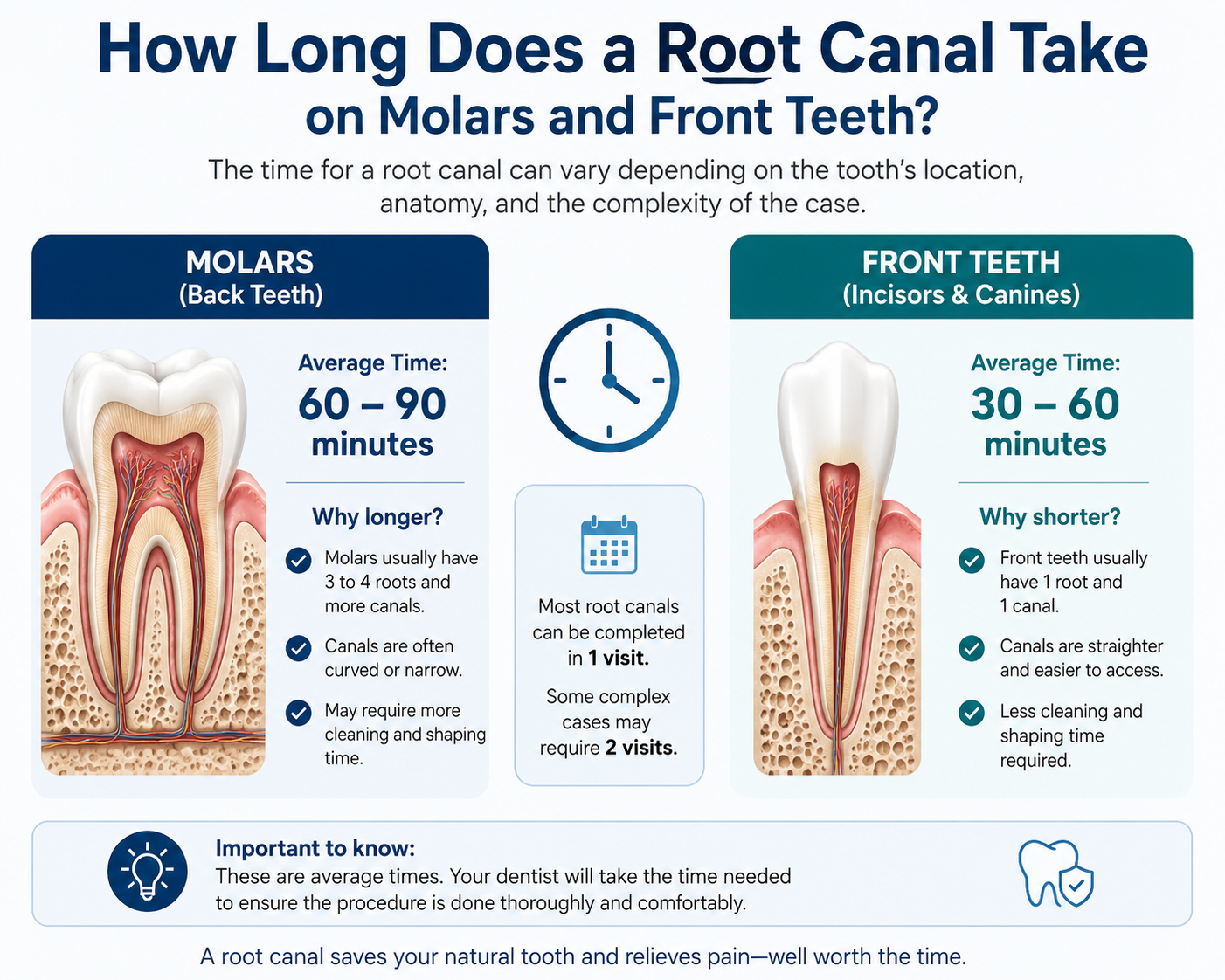
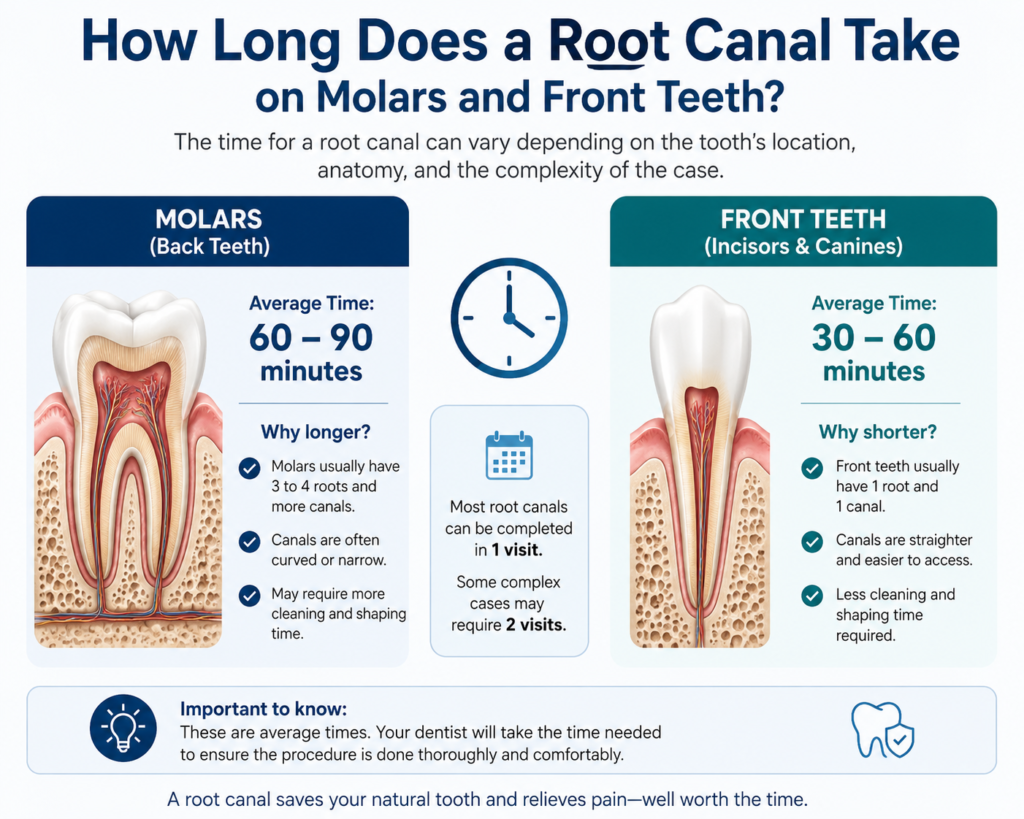
A typical appointment for a root canal usually takes between 60 to 90 minutes.
However, treatment time varies depending on several factors.
Simple root canals for front teeth could take 30-60 minutes.
More complicated procedures that involve Molars usually require 90 minutes or more due to the fact that these teeth have numerous root canals that require meticulous sealing and cleaning.
In certain cases the treatment can be completed in one appointment. In more complex cases, you may need two appointments.
The different teeth’ root structure is distinct which directly affects the length of time treatment takes.
| Tooth Type | Typical Procedure Time |
|---|---|
| Front Incisors | 30-60 Minutes |
| Canines | 45-60 Minutes |
| Premolars | 60-90 Minutes |
| Molars | 90-120 Minutes |
| Complex Retreatment Cases | Multiple Visits |
Molars typically take the longest due to the fact that they typically contain more than four canals which need to be thoroughly cleaned.
The front teeth typically have just one canal, making the treatment quicker.
Many factors influence the length of time that an individual root canal will take.
Smaller infections are usually simpler to treat.
If the infection has spread to a large extent Additional cleaning and treatment could be required.
Teeth that have multiple canals need more time for treatment.
Each canal has to be identified clean and shaped, disinfected and then sealed.
Front teeth are typically easier to reach in comparison to the back teeth.
A better accessibility can cut down on the time needed to complete a procedure.
Crowns, fillings or previous root canal treatments can make the procedure more difficult and prolong the time of treatment.
Certain patients have naturally curving narrow, narrow or unusually shaped canals which require special care.
Understanding the process can alleviate stress and help make it more familiar.
The dentist or endodontist starts with examining X-rays and reviewing the tooth affected.
This can help identify the source of infection and determine the root structure and then plan the treatment.
The tooth’s surrounding area is numbed to provide that the patient is comfortable throughout the process.
Modern anesthetics have made root canal therapy fairly painless for the majority of patients.
Dental dams are put around the tooth in order to ensure it is dry and free of bacterial contamination.
The dentist makes a tiny hole in the tooth that allows it to allow access to the pulp chamber.
Special instruments can remove damaged tissue and create canals of the root.
They are cleaned to get rid of the bacteria.
After cleaning, the canals are then filled with biocompatible material, and then sealed.
Crowns or fillings are used to restore the strength and function.
Yes, a number of root canals are completed within a single visit.
Dental technology advancements have greatly improved the effectiveness of treatments.
One-visit root canals are typically feasible in the following situations:
For a lot of patients, one-visit treatment is convenient and speeds up recovery.
Certain cases may require more than one appointment.
This is usually necessary to:
It is possible to place medication inside the tooth between visits to remove bacteria.
A longer healing period can help increase the effectiveness of treatment.
Additional appointments let dentists handle complex root systems in a controlled manner.
Dental restorations that were previously treated are often required more intensive treatment.
While multiple visits can extend the duration of treatment but they may improve longevity of treatment in certain circumstances.
One of the most popular misconceptions about the root canal is that they can be extremely painful.
Modern root canal procedures are developed to ease discomfort, not cause it.
Many patients report that it’s like receiving a routine filling.
Local anesthesia is effective in numbing the area, which reduces the discomfort that occurs while treatment.
Then, mild soreness can be present for a few days, but it’s generally manageable using over-the-counter painkillers.
Although the process itself could take between one and two hours, the recovery process continues following the procedure.
The majority of patients are able to resume normal activities on the same day.
Common recovery experiences are:
The symptoms usually improve after several days.
Infections that are more severe may need slightly longer healing time.
Patients are advised to wait until the numbness has gone before eating.
It typically takes two to four hours.
Soft foods are generally advised for the first days of your pregnancy.
Examples include:
When the discomfort is gone and any permanent recovery is complete, eating habits can be restored.
A lot of root canal treated teeth require crowns.
A crown can protect the weak tooth and prevents fractures.
If the restoration is not adequate teeth are more susceptible to damage in the future.
Although putting on a crown might require an additional appointment, it dramatically enhances the long-term results.
Root canal therapy is an extremely effective treatments in dentistry.
Rates of success often exceed 90 percent..
If combined with a proper dental hygiene and restoration The teeth treated are able to last for years.
Factors that can contribute to success include:
Patients can make their experience better by following these simple guidelines.
Be well-rested, eat breakfast or a light meal prior to your visit and follow the dentist’s instructions, and take prescription medications as directed, and go to subsequent appointments.
These steps help speed up recovery and lessen the risk of the risk of complications.
Dental technology is constantly evolving to improve the results of treatments.
The majority of practices today employ:
Advanced imaging gives detailed images of the root structure.
Specialized tools boost the efficiency and accuracy.
The enhanced visualization of dental patients allows dentists to detect hidden canals.
Modern filling materials enhance sealing and long-term endurance.
These advancements help to reduce time to complete procedures while also increasing the rate of success.
Patients often delay treatments because of fears or scheduling concerns.
Untreated infections tend to become worse as time passes.
The potential consequences are:
Getting treatment quickly can result in fewer procedures and more positive outcomes.
When you ask how long the procedure of a root canal last the answer is mostly on the tooth that is involved as well as the extent of the issue, and the amount of canals that require treatment. The majority of root canals last between 60 to 90 minutes, however simple cases can be handled more quickly, while complex molars could require additional time or several visits.
Modern dentistry has changed treatment for root canals into an efficient and comfortable procedure which helps preserve natural teeth and eliminates discomfort and infection. Knowing the procedure, its anticipated timeline and the recovery process can make patients feel more secure and ready for treatment.
If you seek treatment promptly and adhering to the recommendations of your dentist You can safeguard your dental health and reap lasting results.
Most molar root canals require between 90 and 120 minutes since the teeth typically have multiple canals.
Yes. Numerous root canals that are simple can be performed in just one visit.
Modern root canals are generally not any more painful than regular fillings due to the effectiveness of local anesthesia.
The majority of patients heal within a couple of days, but tenderness could persist for a few days.
Complex root anatomy or retreatment cases could require multiple appointments to ensure the best results.