Physical Address
Austin, TX, USA
Physical Address
Austin, TX, USA

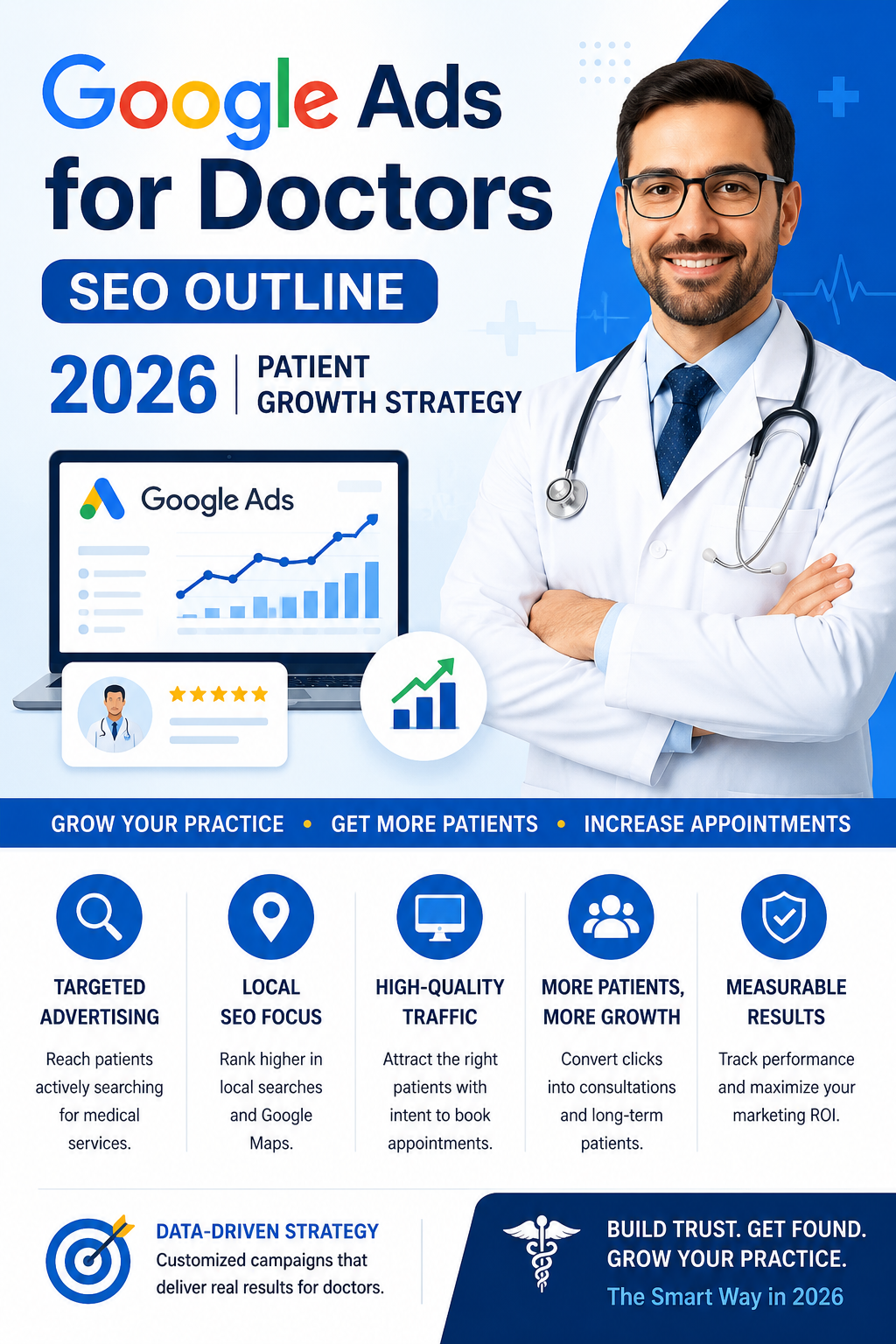
Doctors can no longer get patients’ attention by using only one channel for marketing. A clinic could use Google Ads and get quick calls but in the absence of SEO, customer reviews, solid service pages, or an authentic website costs per patient continues increasing. This is why having a clear Google Ads for Doctors SEO outline is important. It integrates paid search local SEO and landing pages, content and tracking into a system to help doctors reach patients quicker while establishing long-term exposure.
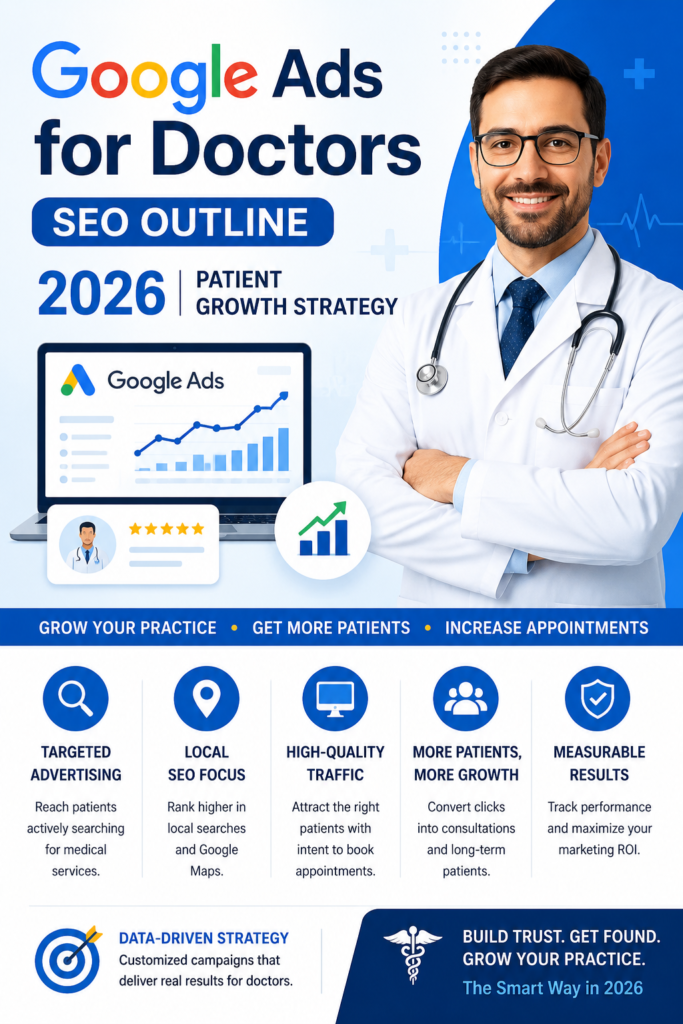
In 2026, patients will search with greater vigor than ever. Patients compare doctors review sites, look up reviews, research the location, ask questions in depth and are expecting clear responses before making an appointment. A well-planned strategy can help your practice to appear in the right place with the appropriate message on the right page.
Google Ads and SEO serve distinct purposes, however, they perform best when utilized in conjunction. Google Ads aids doctors to appear fast when searching for keywords that are high-intent, such as “cardiologist near me,” “dentist open today,” “skin specialist appointment,” or “urgent care clinic near me.” SEO creates long-lasting visibility by utilizing page pages for services, locations useful content, Google Business Profile optimization and patient trust signals.
The problem that clinics are faced with is quite simple. They use ads, but they do not repair their websites. The ads bring visitors, but the site’s landing page doesn’t convert. Or, they invest only in SEO and then wait for months to see results while competitors compete for the highest paid spots. A balanced approach offers doctors stability and speed.
Google Ads can reveal the keywords that bring real appointments. SEO can turn the same keywords into powerful pages that keep bringing organic traffic. Ads help you test demand. SEO assists in reducing the long-term dependency on paid clicks. Together, they build a system for acquiring patients instead of a random marketing campaign.
Before creating a campaign, or creating a page doctors should understand why people use search engines. Someone searching at “back pain treatment near me” isn’t at the same place as a person seeking “what causes lower back pain.” One patient is close to obtaining a treatment. While the other is still learning.
The majority of medical research falls into three categories. Patients may want to know details. They want to know about their symptoms, the cause as well as recovery time and treatment options, as well as risks and costs. Some patients look at different the providers. They look for the top doctor, best hospital, testimonials, locations knowledge, experience, and insurance information. Other people are prepared to act. They look for appointments, emergency services day visits, consultation fees or clinics close to them.
A solid Google Ads to physicians SEO outline should include the three phases. Google Ads should focus more on appointment-ready search because these clicks are costly. SEO should include both commercial and educational searches since content that is helpful builds trust before a patient is in a position to book an appointment.
An effective strategy begins with the structure. Doctors shouldn’t run a general campaign for each service. This leads to wasted money and a lack of relevance to the ad and inadequate conversion tracking. Each specialty, treatment or service needs an ad or campaign group, based how big the business.
For instance, a dental clinic could have make separate dental implant campaigns Invisalign, emergency dentist teeth whitening, root canal therapy. A dermatology clinic could segregate mole examinations cosmetic dermatology, treatment for eczema, as well as skin cancer testing. A physiotherapy practice could be separated the back pain of sports injuries back pain and neck problems, as well as post surgical rehabilitation and workplace injury care.
Each campaign should be linked to a specific landing page. The landing page must match the specific service that is being promoted. If the advertisement is focused on dental implants the landing page must not be a generic dental services page. It must clearly explain the benefits of dental implants and answer questions from patients, demonstrate trust, provide the location of the clinic and allow for easy booking.
The SEO aspect should adhere to the same format. Every major business needs an optimized page for search. Every major location requires an individual landing page. Each common question asked by patients could be a support Article or FAQ. This helps establish authority in the specialty of the doctor.
| Area | Google Ads for Doctors | SEO for Doctors |
|---|---|---|
| The main function | Fast visibility for high-intent Google | Develop long-term organic visibility, and build trust |
| Best use | Keywords for appointment such as urgent searches, competition treatments | Location pages, Service pages FAQs, educational content |
| Speed | Rapidly generate traffic after the launch | It usually takes longer to build rank strength |
| Cost | Pay per click or for leads | Pay for content, optimization, as well as technical work |
| Main risk | The budget was wasted because of poor keyword selection, weak websites or policy issues | Results are slow if the quality of content and authority signals are not strong |
| The most accurate Metric | Price per scheduled appointment | Organic leads, ranking, calls maps visibility, organic leads and conversions with assistance |
The table illustrates the reasons why one channel shouldn’t be used to replace another. Google Ads gives speed. SEO can provide a long-lasting power. Doctors, for instance, get the most effective results are usually obtained by paying for search results to meet immediate interest, while SEO establishes credibility around locations, services and even patient queries.
The research of doctors’ keywords should be focused on the language of patients not just medical terminology. Patients might not search for conditions in the same way that doctors do. Doctors may use the term “rhinitis,” while a patient is searching for “constant runny nose.” A specialist in spine may refer to “lumbar disc herniation,” while a patient might search “slipped disc treatment.”
To use Google Ads, start with the keywords that demonstrate intent to book. These are typically phrases such as “near me,” “appointment,” “clinic,” “doctor,” “specialist,” “same day,” “open now,” “cost,” “consultation,” and the city or region name. These kinds of searches tend to be more likely to transform into phone calls or form submissions.
Negative keywords are equally crucial. Doctors need to block irrelevant searches including jobs, salary courses, free PDF, school images, home remedies and any other irrelevant locations. Without negative keywords, campaigns can invest money in those who aren’t looking for help.
The most effective campaigns separate the urgency of a campaign from the research intention. “Emergency dentist near me” is not a good idea to be within the same ad group with “what is tooth sensitivity.” A direct announcement to book. Another is best handled by SEO-based content.
SEO keyword mapping transforms search results into a precise website strategy. Every key phrase should be able to have its own destination page. A clinic shouldn’t try to rank a single homepage for each service. It makes the website too wide and weak.
The homepage should be focused on the primary brand, main specialization, and the primary location. Service pages should focus on treatment-specific specific searches. Location pages should be targeted at the city or neighborhood. Blog posts should provide answers to frequently asked questions from patients. FAQ sections should facilitate search engines that use answers and improve clarity.
For instance, a cardiology practice might create pages for heart checks, ECG test, chest pain consultation, hypertension treatment cholesterol management, and risk assessment. Each page should state who the service is intended for and the procedure for the appointment, the reason why the doctor is a qualified specialist and what the patient can be expecting, and the best way to make an appointment.
A well-constructed page isn’t only written to be viewed by search engines. It can help patients feel safe and secure. This is crucial for medical SEO since patients require accuracy, confidence and clear directions for the next steps.
A landing page for medical professionals should be clear, calm and simple to use. Patients don’t need to sift through a maze of information when they are concerned about their health. They want quick confirmation they’re in the correct location.
The page’s top should clearly mention the clinic’s location, services and the main advantage. It should also include a prominent call button, an appointment button, and a few trust indicators like years of experience and qualifications, reviews and clinic locations or availability on the same day in the event of a the case.
The webpage should provide a clear explanation of conditions or treatments in simple English. The page should not contain exaggerated claims. Medical copies should be credible, but not sloppy. Instead of using the phrase “guaranteed cure,” use precise language such as “personalized treatment plan,” “thorough assessment,” or “care based on your symptoms and medical history.”
The landing pages of a strong landing page also provide information on the questions of cost as well as insurance, appointment duration recovery, risk, and the kind of care to anticipate. The less doubt you eliminate from the equation, the more likely patients will book.
Ad copy for doctors must not appear like a discount shop. Patients want treatment, not hype. The best advertisements are concise and local. They also reassure. They provide information about the location, service the patient’s needs, and the next step.
A weak ad says, “Best doctor. Make an appointment now. The offer is only available for a limited time.” The more prominent advert states, “Back Pain Clinic in Austin. See an Experienced Spine Doctor. Same-day appointments available.” This second option has more precise information and reflects the patient’s needs.
Doctors should try different angles. Some patients prefer ease of access, such as same-day appointments or booking online. Others respond to the expertise of their doctor like board-certified physicians or specialists-led treatment. Others are more comfortable by offering gentle care and clear pricing or a family-friendly experience.
Extensions to ads are equally essential. Location assets, call assets sitelinks, structured snippets of text, and appointment links can increase visibility and assist patients to respond. For clinics, calls are usually among the most profitable conversions, therefore calling tracking must be carefully set up.
Local SEO is among the most important aspects of marketing for medical professionals. Patients are constantly searching for a doctor near their work, home or at school. An optimized Google Business Profile can help the practice show up in search results for maps, local search results, and even search results that are branded.
The profile should include the correct name of the clinic address, number, and address and website address, as well as opening hours, hours of operation appointment link, service categories, photographs and descriptions. Incomplete profiles reduce trust. Inaccurate information could cost you real time appointments.
Reviews also play a role. Patients are often comparing clinics prior to making a decision to call. An ongoing review process will increase trust and boost local recognition. Doctors should request positive reviews from satisfied patients with respect. The responses to reviews must be professional and avoid sharing personal health information.
The site should be able to support local SEO as well. The same clinic’s name address, address and phone number must be shown in a consistent manner across the site as well as the major search results. Pages for services should include the city’s name naturally. Pages on location should include the parking information, the nearby areas covered, clinic hours and clearly outlined directions.
The content for medical professionals should be useful as well as accurate and understandable. A well-designed content strategy can answer the questions that patients have before scheduling. It shouldn’t be overloaded with keywords or stuffed with paragraphs of thin text that duplicate the same concept.
Doctors may write about symptoms of conditions, treatments, treatment, recovery, costs preparation, prevention and when to visit an expert. For instance dermatologists may write about mole changes, eczema triggers tests for skin allergies and removal of warts. A dentist could address dental pain, implants, dental veneers as well as emergency dental visits.
Each post must have a specific purpose. Some articles should be educational. Some posts should provide information on treatments. Others should direct patients to an appointment when professional assistance is required. The aim is to establish confidence before the patient even gets to the appointment page.
To ensure greater authority medical websites should clearly state who wrote or reviewed the content. Credentials, bios of the doctor as well as experience in the clinic and review dates can help readers understand why the information is trustworthy.
AEO helps your content answer direct questions clearly. GEO makes your content more comprehensible, simplify and use across the latest searches. In the case of doctors, that means that pages must provide direct responses to natural questions asked by patients and organize the information in a manner that is simple to read.
Instead of composing a vague section such as “About Our Services,” make sure you use more specific headings like “Who Is This Treatment For?” “What Happens During the Appointment?” “How Long Does Recovery Take?” and “When Should You See a Doctor?”
Short answer sentences are helpful. A patient who asks “How much does a dermatologist visit cost?” is looking for an accurate explanation prior to reading more details. A patient who asks “Is chest pain always serious?” requires a thoughtful and responsible answer that will encourage an appropriate medical examination when required.
FAQ sections are also effective when they are used correctly. They must answer genuine questions, and not just repeat the same keywords. The most useful FAQs come from telephone calls, questionnaires for patients, consultation questions, Google Search Console data and People Also Ask results.
In the absence of tracking data, physicians can’t determine which campaigns have the most impact on patients. A few clicks is not enough. A campaign could get lots of clicks but not many appointments. A different campaign might receive fewer clicks, however it will have higher quality appointments.
The most significant conversions include phone calls and appointment form submissions. They also include online bookings, directions requests and qualified leads. Clinics must also monitor which pages on their website generate organic leads, and which advertisements result in booked consultations.
Call tracking is especially beneficial for doctors since a lot of patients prefer to talk to someone prior to making an appointment. However, it is important to be done with care to ensure that the clinic can maintain constant contact information across all the local area.
The most effective reporting doesn’t just display the amount of traffic. It provides cost per lead, price for booked appointments, conversion rate for landing page, quality of the keyword missed calls, call duration and the source of the patient. This aids the clinic in improving both front desk and marketing performance.
Google Ads budgets are based on the location, specialization competition, and value. A small family practice located in an area with low competition may require a modest budget. Plastic procedure, dental implant, fertility, legal-medical or specialty clinic in a large city could require a larger budget to keep up with.
The proper budget must be built on math and not based on guesswork. Start by determining the value of a new patient average revenue from treatment close rate, an acceptable price per purchase. Next, you must determine the amount you will spend on each lead.
Many doctors make the error of distributing a limited budget over too many different services. It is best to concentrate on just a few important services first. When the campaign has sufficient information, the procedure could expand to include more options and sites.
SEO budgets should be carefully planned. The clinic will require technical improvements as well as content for service pages such as location pages schema, internal linking, Google Business Profile work review strategy, as well as regular content. Cut corners often lead to pages that are not able to get ranked or converted.
This checklist helps keep the focus of the plan. Doctors are not required to tackle everything at once. They should establish the proper foundation first and then make improvements based on evidence.
The most common error is sending all traffic generated by ads directly to the main page. The homepage is typically too wide. When you click an advertisement, patients for a specific treatment will be directed to an information page on the treatment.
Another error is to use broad match keywords with no control. Broad matching could result in unnecessary clicks when negative terms, local targeting, and conversion tracking aren’t strong. The doctor should check the search terms frequently and eliminate bad matches.
Some clinics are also not aware of mobile devices. The majority of patients use phones to search for information. If the website loads slow or the call button is difficult to locate or the request form takes too long to fill out, the practice will lose leads.
Another problem is the lack of trust signals. Patients need to know who the doctor is as well as where the clinic is and what kind of experience their team members have as well as what patients have to say about the clinic. Without these details even a good website may not be converted.
Certain practices also release medical-related content that is not reviewed by an expert. When it comes to healthcare, accuracy is important. Content must be concise and accountable. It should also be aligned with the services that the clinic actually offers.
For the initial 30 days concentrate on establishing the foundation. Check the website’s audit, review Google Business Profile, review the tracking system, look up maps, keywords and then create the first landing pages. This phase must also include reviewing competitors and checks on call handling.
Days 31-60 should be focused on launch and learning. Use Google Ads to get the most effective services. Examine search terms, stop weak keywords, enhance the copy of ads, and then check landing page adjustments. In the meantime you should publish or update your the basic SEO web pages that serve as service pages.
Days 61-90 should be focused on expanding. Create supporting content, strengthen internal links, develop websites for locations if required as well as strengthen reviews. modify campaigns based upon scheduled appointment data. This is when the process shifts from guesswork to measuring growth.
The aim isn’t just increasing leads. The objective is higher quality leads, less loss, more trust, and a more smooth route from search to appointment.
A doctor’s website must be easy to navigate and well-organized. The main menu should assist patients quickly locate the services, information about the doctor such as location, insurance information or review information, payment details and appointment options.
The homepage should present the practice and lead users to essential services. Pages for service should go deeper into each procedure. Profile pages of doctors should create trust by presenting credentials, experiences specialties, as well as a personal biographical information. Location pages should be designed to support local searches and aid patients plan their visits.
The blog or the learning section should provide answers to the most frequently asked questions, but is not meant to replace the pages of service. A blog post on “how to know if you need a dermatologist” helps with SEO. A page of services for “dermatologist in Chicago” captures the intention to book. Both are important, but they have different functions.
Internal linking is essential. Blog posts should include links to relevant service pages. Service pages should include links to physician profiles as well as FAQs appointments pages, FAQs, and related treatments. This allows users to move easily through the site and help search engines comprehend the structure of pages.
Medical advertisements require extra attention. Doctors should stay clear of false promises overstated claims, exaggerated claims, fears-based language, as well as unsubstantiated prior-and-after messages. The aim is to educate and direct, not push.
Advertisements and landing pages must reflect the service actually offered. If a clinic is advertising an option that is not available, the landing page must describe the procedure in a clear and responsible manner. If a treatment has eligibility limitations it should be made the rules explicit. If consultations are mandatory, mention it.
Trust isn’t just about policies. It’s also about patient trust. The clear guidance on pricing, the authenticity of physician profiles, photos of clinics exact hours, friendly receptionists and honest reviews all boost conversion rates.
SEO can lower paid media pressure over time. When a page for a service ranks organically, a clinic will receive leads and not pay per click. If Google Business Profile performs well it allows more people to find the clinic on Google Maps and Local Results. If content can answer questions from patients it builds trust before making the first call.
SEO can also boost Google Ads performance indirectly. Improved pages can enhance user experience and increase conversion rates. A more robust and compelling content will improve the appearance of the clinic and make it more professional. The clear service pages will aid visitors in understanding the importance of making a reservation.
The most efficient practices utilize Google Ads data to enhance SEO. If a paid-for keyword generates good quality leads, it might be a good idea to have a dedicated SEO page. If a question from an advertisement appears frequently in phone calls, it might be a good idea to have an FAQ. If a site is successful in ad campaigns and calls, it might be in need of more local SEO assistance.
An effective Google ads designed for physicians SEO outline isn’t just an outline for marketing. It’s a system for growth for medical practices who want more qualified leads for patients without wasting money. Google Ads assists doctors to be visible when patients are waiting to book. SEO creates long-term exposure as well as trust and authority. SEO that is local SEO helps connect the office to local patients. A well-designed landing page converts visits into calls and appointments.
The most effective strategy for 2026 is clear, focused and patient-focused. Select the best services focus on the most relevant keywords, create specific pages, measure real conversions, improve reviews, and continue to improve by analyzing research. Doctors who mix paid search and SEO are not only able to get more visitors. They also create a reliable route from the search of a patient to a booked appointment.
The most effective strategy is to concentrate on high-intent patients’ searches and then make sure that each ad is placed on an individual landing page for service. Doctors should differentiate campaigns based on the type of treatment, make use of targeted location-based targeting, include negative keywords, keep track of calls as well as bookings, and enhance campaigns based on actual appointment information.
SEO and Google Ads do different jobs. Google Ads can bring faster exposure and increase traffic, whereas SEO can help build long-lasting natural traffic as well as trust. For the majority of doctors, the best strategy is to utilize Google Ads for quick patient leads, and SEO to ensure steady growth in the long run.
The ideal budget will depend on specialization, location competition, specialty, and the worth of a new patient. The clinic should begin with the best-performing services, and track the cost per booked appointment and then increase the amount only if the campaign generates qualified leads.
A doctor’s website must have a solid page on the homepage, pages of service for every procedure, location pages for clinics that serve different areas, doctor profiles and review or testimonial sections including FAQs, contact information as well as helpful educational content based upon patient queries.
Doctors can increase leads through using Google Ads, local SEO and service page optimization. Google Business Profile improvements, reviews from patients, quick mobile pages with clear calls to action and precise conversion tracking. The aim is to create a platform that makes it simple for patients to locate their way to trust and reach the clinic.