Physical Address
Austin, TX, USA
Physical Address
Austin, TX, USA

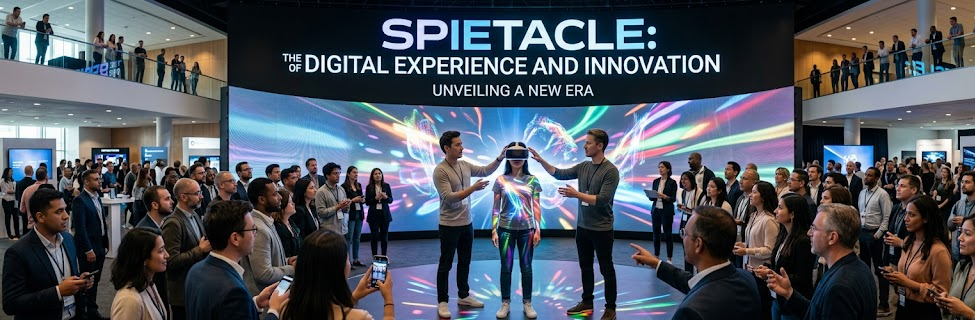
The digital landscape is evolving more quickly than ever before. Innovations tools, technologies, and experiences change the way people engage with technologies. In this fast-changing environment, a new concept is starting to gain attention–spaietacle.
At its heart spaietacle is a paradigm shift in the way digital experiences are created and delivered. It is a departure from the traditional design or content by combining intelligence, creativity and interaction with users to create an immersive and seamless experience.
What exactly does this mean in real terms? And why is it vital?
Spaietacle explained in simple terms. Discover how it transforms digital experiences with creativity, interaction, and modern innovation.
Spaietacle is best described as a new method of digital interaction in which content is not simply viewed but also experienced.
Instead of static designs or simple interfaces, it is focused on creating environments that are responsive to the user’s the user’s behavior, and provide an experience that is more immersive.
It is a blend of several elements:
It’s a platform where people don’t just consume content but actively participate in it.
The way that people use online platforms is changing. Customers expect more than just basic functions. They expect experiences that are effortless, personal and fun.
Traditional methods often fail since they are focused on providing information.
Spaietacle shifts focus to the user experience in design.
This method is receiving interest because of:
In an increasingly competitive digital world the factors mentioned above are a major factor.
On a deeper level spaietacle’s mission is to combine the power of creativity and intelligent systems.
It’s not only about what it looks like however, it’s also about how it behaves.
A spaietacle-driven experience is tailored to the individual. It’s natural, responsive and natural.
This creates a sense flow, where users can are able to move around content with no friction.
Traditional digital experiences are generally unidirectional. Users scroll, click, and read.
Spaietacle creates a sense of interaction and is lively.
Instead of a fixed path Users encounter:
This makes for a more exciting journey, in which the experience changes based on the user’s behavior.
Spaietacle isn’t limited to a single industry. It is applicable to diverse digital platforms.
In websites, it helps improve user interaction and navigation.
Through apps, this improves personalization and usability.
Digital marketing creates campaigns that make you feel active instead of static.
In the context of learning platforms, it could change the way that information is presented and make it more enjoyable and easy to comprehend.
Traditional design is focused on layout and structure. It helps ensure that information is well-organized and easy to access.
Spaietacle goes even further by focusing on the experience and interaction.
In place of a question like “Does it look good?” It asks:
“Does it feel natural and engaging?”
This transformation changes the way digital products are constructed and how consumers engage with them.
Businesses are beginning to realize that their the attention span of users is very limited.
If the experience is unresponsive, confusing, or boring, users are likely to leave fast.
Spaietacle assists in solving this problem by generating experiences:
This results in better outcomes regardless of whether the goal is sales, engagement or retention of users.
Creativity is an integral part of this notion.
It’s not only about aesthetics. It’s about how the various elements interact.
The experience of a creative spaietacle is effortless, rational, and fun.
It helps users learn naturally instead of requiring them to figure things out.
Although the idea is enticing but implementing it isn’t always simple.
One issue is complex. Interactive experiences require the coordination and planning.
Another problem is balancing. Too too much interaction can be overwhelming for users instead of assisting them.
Additionally, there is a need for expertise in technical areas to design and maintain these systems.
However The benefits usually surpass the effort.
Startups are a benefit since they can be more flexible.
They are able to experiment with fresh ideas without being restricted by the old system.
By paying attention to user experience at the very beginning, they can create platforms that are distinctive.
Even tiny improvements in interaction and accessibility can be a massive impact.
With technology continuing to develop how important user experiences are will grow.
Spaietacle is expected to become more widespread because platforms and tools enable the creation of interactive environments.
Future developments may include:
This makes digital experiences more personalised and responsive.
There is no need for a full transformation to get started.
Start by focusing on user behavior.
Learn how users interact on your platform and pinpoint areas where the user experience could be enhanced.
Small changes can decrease friction and increase flow.
As time passes, these changes will result in a more enjoyable and efficient system.
It is increasingly increasingly aggressive.
The users have more choices than ever before, as well as their demands are rising.
Spaietacle solves this by focusing on what really is important in the end: user experiences.
It assists in creating spaces that aren’t just functional, but also enjoyable and fun.
This makes it an excellent method for those working in digital environments.
Spaietacle offers a fresh method of looking at digital experiences.
It goes beyond the simple design, and is focused on generating engaging, interactive and user-centric environments.
In combining technology, creativity and smart interaction, it provides an effective approach to creating contemporary digital applications.
As the expectations of users continue rise, methods such as spaietacles will have a significant role to play to determine the direction of interaction in digital form.
It’s a fresh method of digital experiences which is centered around interaction with users, engagement, and user-centric design.
It is about interaction and experience rather than structure and layout.
It is possible to use it on apps, websites marketing, as well as digital platforms.
Yes, it improves engagement retention, engagement, and the overall experience for users.
Even small improvements in the way we interact can make a significant difference.