Physical Address
Austin, TX, USA
Physical Address
Austin, TX, USA

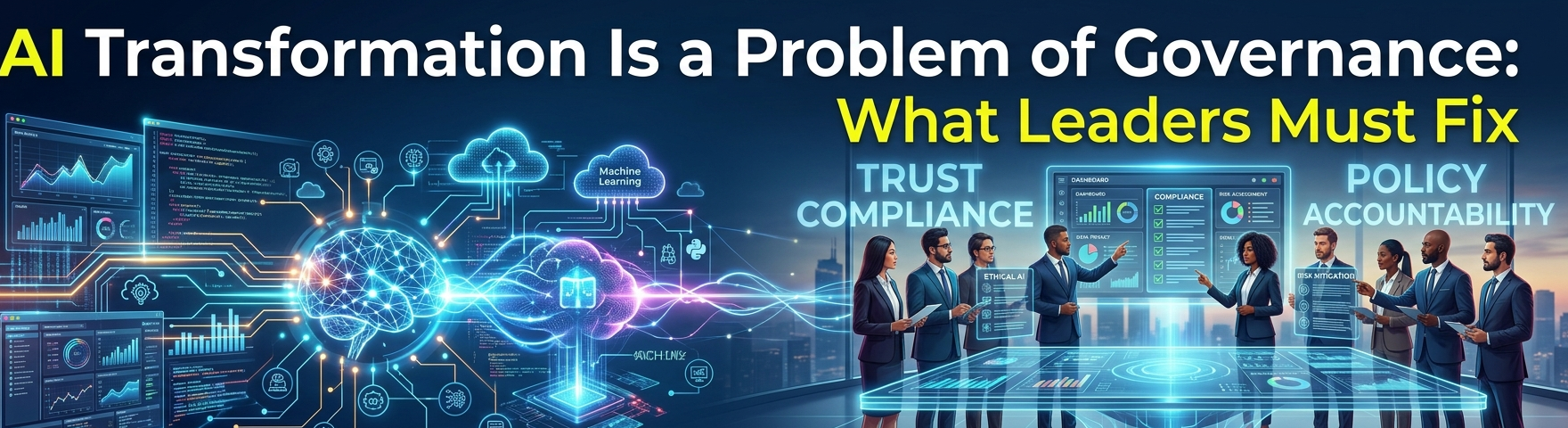
Artificial Intelligence is no longer an idea that is only a few years away. It is already changing the way organizations function take decisions, manage their operations, and provide benefits. But, despite a significant investments in technologies and tools numerous companies are struggling to get real outcomes out of the AI initiatives.

The subject is frequently not understood.
It is not just a technical challenge. It is not only about data or infrastructure. In many cases, AI transformation is a problem of governance.
The main challenge is how the decisions are taken, the way in which responsibility is defined, and the way systems are managed. Without an understanding of the rules of governance, even most sophisticated AI systems are unable to provide consistently reliable results.
Understanding this change in perspective is vital for any business looking to be successful by implementing AI.
When we talk about AI transforms are a matter of governance We refer to the gulf between decision-making and technology.
Governance is the term used to describe the structures, policies and processes that determine the way an organization functions. With regard to AI governance, it encapsulates:
Without these components, AI systems operate in the midst of inertia. They can function technically, however, they aren’t able to provide direction accountability, direction, and alignment with business objectives.
Many businesses adopt AI using a wrong perspective. They rely heavily on platforms, tools and automation, believing that technology alone can solve their problems.
This can lead to common problems:
In the beginning, AI projects are launched with no having a clear understanding of who is responsible for the project. Teams are split up, and nobody is held accountable for their results.
The second reason is that there is usually an inconsistency among AI initiatives and the business strategy. The projects may be impressive in terms of technology but they fail to provide the value they promise.
Thirdly, ethical and regulatory issues are often treated as a secondary consideration which creates dangers which could have been prevented.
These challenges show the need for governance to play a major function.

To appreciate why good governance is so vital is to examine its most important elements.
A very essential features of AI is responsibility. Each AI system must be able to demonstrate the clear responsibility of its own. Someone has to be accountable for its performance and what its outputs are used for.
Another important aspect that is essential Transparency. It is essential for organizations to know the way in which their AI system makes decisions. This is particularly important in situations where decisions impact individuals directly.
Governance of data is also crucial. AI systems depend on data which is of poor quality, which will result in poor performance. A proper management of data ensures the accuracy and reliability.
In the end, risk management plays a significant role. AI introduces new kinds of risk, including security risks, biases and unintended outcomes. These risks need to be recognized and controlled in a proactive manner.
Solid governance is a prerequisite for a successful AI transformation.
When the rules of governance are transparent, teams function more effectively. There’s less confusion around the roles and responsibilities of each team member and the decisions are taken more quickly.
It also increases confidence. The stakeholder base is more likely to back AI initiatives when they know the process of making decisions and how risk management is handled.
Governance also ensures stability. AI systems function in predictable ways, which is crucial for the long-term viability of AI systems.
In the absence of governance, even well-designed systems may produce unreliable or even harmful results.
Implementing governance isn’t always simple. Many companies struggle with the issues that are practical.
A common problem is resistance to the idea of change. Teams may be accustomed to the current processes, but are hesitant to change their processes.
Another problem is its complexity. AI systems often involve multiple departments, making coordination difficult.
Also, there is the problem of speed. Businesses need quick results, however management requires a careful plan and monitoring.
The balance between speed and control is among the most difficult issues when it comes to AI transformation.
To be successful they must change their strategies.
Instead of asking “What AI tools should we use?” They should be asking “How will we manage and control AI systems effectively?”
The shift changes everything.
This leads to better planning that is more precise in its priorities and more long-term results. It will also ensure the AI initiatives are in line with larger goals of the business.
However, this does not mean that technology isn’t important. It is just that technology needs to be accompanied by a solid governance.
The process of improving governance doesn’t require the complete overhaul. It can be accomplished incrementally.
It is important to establish clearly defined roles and the responsibilities. Every person who is involved with AI projects must be aware of their roles.
Next, you should establish guidelines for how data is used. This includes how data will be obtained, stored and processed.
It is equally important to develop procedures to monitor AI systems. Regular evaluations help identify issues earlier and improve performance.
Also, get leadership involved. Governance needs support from the top in order to be effective.
The leadership role plays a crucial part in determining the way AI is implemented within an organisation.
The leaders set priorities and determine the direction for the entire organization. Without their help Governance efforts are often unsuccessful.
They also play an important role in creating an environment of accountability. This is by promoting ethical behavior and promoting the practice of transparency.
A strong leadership team ensures that governance isn’t simply a list of rules, but an essential aspect of how the company runs.
Ethics is an integral part of governance.
AI systems have the potential to be a major influence on the lives of people. The decisions made by these systems have to be unbiased and fair.
Companies must take into consideration:
The solution to these problems requires specific policies and constant focus.
As AI continues to develop and improve, governance will become more crucial.
The number of regulations is expected to rise and businesses will need to adhere to new standards.
However, AI systems will become more complex, and require more sophisticated governance structures.
Companies that invest in governance right now will be better equipped for the future.
Recognizing how AI transforms is an governance issue alters how companies approach AI.
It shifts the focus away from strategies to tools and from automation to accountability and from the speed of progress to sustainable.
This way of thinking assists in avoiding common pitfalls and provides a better base for success.
AI can change the way companies operate, but its it’s not just about technology.
If there isn’t proper oversight, AI initiatives can become fragile as well as risky and ineffective. If they have a strong, dependable governance system AI projects become well-organized solid, reliable, and in line with the business objectives.
Recognizing that AI transformation is a problem of governance is the first step toward building systems that truly deliver value.
Since success is contingent on the ability to make decisions as well as accountability and control not only technology.
It refers to the rules process, structures, and processes that govern the way AI systems are designed and implemented.
Most of the time, there is no. A lack of management can cause uncertainty, risk and bad outcomes.
By defining roles, coordinating information properly, and setting clearly defined policies and supervision.